
In large-scale event environments and commercial installations, selecting an outdoor transparent led display requires balancing multiple performance factors. Among these, transparency and brightness directly influence visual clarity, environmental integration, and overall system usability. Unlike conventional solid LED panels, transparent display systems must maintain image quality while allowing light and background visibility to pass through the structure.
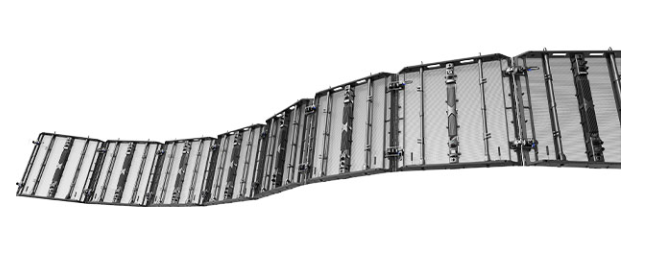
For project planners, understanding how these two parameters interact is essential when evaluating solutions from a transparent led screen manufacturer.
Transparency Ratio and Visual Integration
Transparency defines how much light can pass through the display structure. In a transparent led video screen, this is typically expressed as a percentage, which varies depending on pixel pitch and module design.
Higher transparency levels, such as up to 50% in certain configurations (e.g., P7.8), allow the display to integrate with surrounding environments. This is particularly relevant in stage design, glass façade installations, and architectural media, where maintaining depth and background visibility is part of the visual requirement.
However, increasing transparency reduces pixel density. This means that while the structure appears lighter and less obstructive, the image may have lower visual solidity when viewed at close range. For this reason, transparent systems are generally selected based on viewing distance and content type rather than maximum resolution.
Manufacturers such as YES TECH, operating as a led display screen manufacturer, design transparent modules to balance these factors by optimizing LED spacing and structural layout.
Brightness Requirements in Outdoor Environments
Brightness is another critical parameter, especially for outdoor applications where ambient light conditions can significantly affect visibility. For an outdoor transparent led display, brightness levels can reach up to 5500 nits, depending on the configuration.
High brightness supports visibility under direct sunlight and ensures that content remains distinguishable in open environments. However, brightness alone does not determine display quality. It must be considered alongside transparency, contrast, and viewing angle.
In transparent systems, light passes through both the display and the background, which can reduce perceived contrast. To compensate, higher brightness levels are often required compared to non-transparent LED screens.
For event-based installations, such as a video wall for events, brightness must also be adjustable to suit different lighting conditions, including daytime outdoor use and nighttime stage environments.
Interaction Between Transparency and Brightness
Transparency and brightness are interdependent. As transparency increases, the amount of emitted light per unit area decreases due to reduced LED density. This creates a trade-off:
Higher transparency → lighter structure, better background visibility
Lower transparency → stronger image density and contrast
To maintain visibility, systems with higher transparency often rely on increased brightness output. This ensures that content remains visible even when part of the light passes through the structure.
In engineering terms, selecting the appropriate configuration involves evaluating:
Viewing distance
Ambient lighting conditions
Content type (text, graphics, or video)
Installation environment (indoor vs outdoor)
A transparent screen used for stage backdrops may prioritize visual integration, while a commercial display in a high-light environment may require higher brightness to maintain readability.
High-Frequency Dimming and Image Stability
In addition to brightness levels, how the display controls light output is also important. Transparent LED systems may use PWM dimming with frequencies up to 7680 Hz. This high-frequency dimming method supports stable brightness control and reduces visible flicker during camera capture.
For live events, broadcasting, and recording scenarios, this characteristic helps maintain consistent image quality, especially when the display is used as part of a led screen for event setup. It also contributes to smoother visual transitions when brightness adjustments are required in changing lighting conditions.
Adaptability Across Different Applications
Transparent LED systems are often used across multiple scenarios, including:
Stage and event production
Commercial advertising displays
Architectural media façades
To support these varied applications, some systems allow switching between transparent and non-transparent modules (e.g., in P5.9 configurations). This enables a single structure to function both as a transparent display and as a standard LED screen, depending on project requirements.
For companies operating as a rental led screen supplier, this adaptability can simplify equipment planning and improve utilization across different projects.
Practical Selection Considerations
When evaluating an outdoor transparent led display, decision-makers typically consider:
Transparency ratio (e.g., up to 50%)
Brightness level (e.g., up to 5500 nits)
Pixel pitch and viewing distance
Dimming method and frequency
Structural design and installation flexibility
These parameters determine how well the system performs in real-world conditions, particularly in environments where both visibility and integration are required.
Manufacturers such as YES TECH develop transparent display systems that address these requirements through modular design, optimized LED layout, and adaptable configurations.
Conclusion
Transparency and brightness are fundamental factors in the performance of a transparent LED display system. Rather than optimizing a single parameter, effective system design requires balancing structural openness with sufficient light output to maintain visibility.
For applications involving transparent led video screen installations, especially in outdoor and event environments, understanding this balance helps ensure that the display meets both visual and operational requirements. Systems designed with adjustable brightness, high transparency, and stable dimming behavior provide a practical approach to diverse installation scenarios.
