
Commercial environments demand strict adherence to acoustic standards, as energy storage assets often sit in close proximity to workspaces and pedestrian zones. Traditional air-cooled architectures rely on large arrays of high-speed axial fans, which generate significant aerodynamic noise and turbulent airflow. A hypercubeC&I solution mitigates this issue by employing a liquid-based thermal exchange process. This architecture replaces the constant drone of large-volume air movement with localized, electronically controlled fluid loops, creating a significantly quieter operating environment for facility operators.
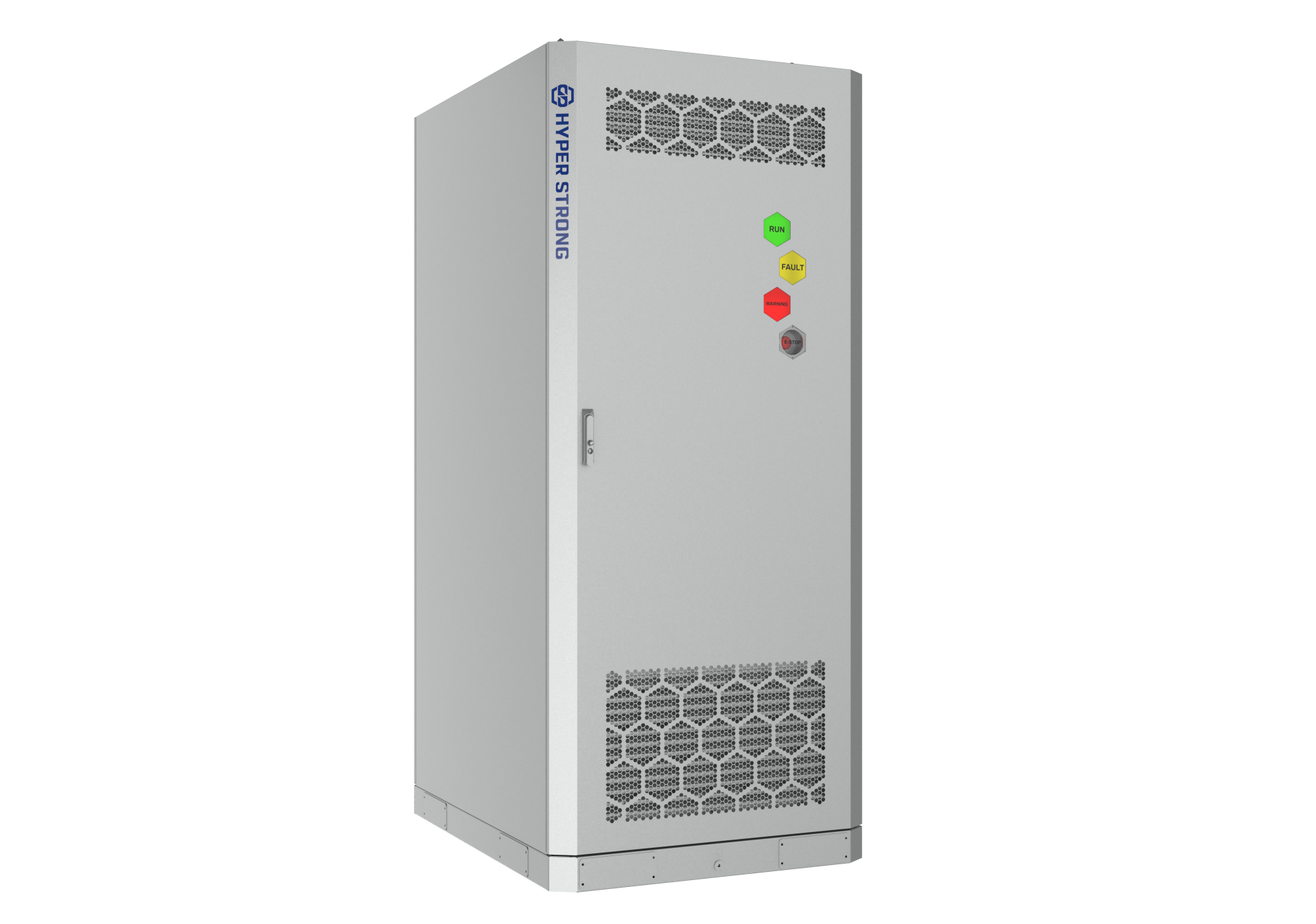
Acoustic Engineering with hypercubeC&I
Effective sound reduction begins with the elimination of high-speed air-moving components. A hypercubeC&I unit utilizes a coolant circulation loop that transfers heat via cold plates directly coupled to battery modules. The primary heat rejection occurs at an integrated heat exchanger, which can be optimized for lower airflow velocities. By minimizing the volumetric flow rate required for cooling, the system substantially lowers the broadband noise typically associated with turbulent air discharge in traditional energy storage installations.
Engineering teams often implement advanced vibration isolation to further suppress noise transmission. Pumps and piping assemblies are mounted on dampened foundations to prevent structural resonance within the cabinet frame. By decoupling the mechanical components from the exterior enclosure, the design prevents the casing from acting as a resonator. This systematic approach to noise mitigation ensures that the mechanical vibrations inherent to fluid transport do not radiate as audible sound from the external cabinetry.
Technical Performance of a Battery Liquid Cooling System
A high-performance battery liquid cooling system relies on variable-frequency pumps to match thermal output with real-time cell temperatures. Unlike fixed-speed fan arrays that cycle in abrupt on/off stages, variable-frequency drives allow the coolant flow rate to ramp up or down smoothly. This gradual adjustment eliminates the sharp acoustic transients that occur during sudden startup sequences. Precise control ensures that the pumps maintain the lowest possible speed required to stay within target temperature setpoints, minimizing decibel output during low-load operation.
Furthermore, internal acoustic enclosures play a critical role in dampening the sound profile. Engineers utilize high-density sound-absorbing liners within the heat exchanger compartment to attenuate mid-to-high frequency mechanical noise. When compliant with industry standards like ISO 3744 or ISO 7779, these measures ensure that sound power levels are validated through standardized testing. Such technical rigor provides facility developers with the reliable acoustic data needed to ensure their installations meet local municipal noise ordinances and commercial occupancy requirements.
Managing System Noise in Diverse Installations
When system designs include auxiliary heat rejection units, such as radiator-mounted fans, they often utilize electronically commutated (EC) motors. These motors offer superior efficiency and allow for precise speed regulation compared to traditional induction motors. By integrating these fans with smart control logic, the battery liquid cooling system avoids running fans at maximum revolutions per minute unless environmental conditions necessitate extreme heat dissipation. This intelligent control logic is essential for maintaining a low acoustic profile in high-density urban areas.
In scenarios where the heat rejection unit must be physically separated, acoustic barriers are installed to redirect the remaining sound waves. These barriers, combined with the inherently lower noise floor of liquid-based heat transfer, allow for installation flexibility. Developers can place equipment near building perimeters without triggering the need for extensive sound-deadening infrastructure. This reliability in acoustic performance simplifies the overall site planning process, as the mechanical noise remains predictable and consistent across various seasonal operating conditions.
Optimizing Thermal Stability and Acoustic Longevity
Consistent thermal management ensures that the battery chemistry avoids the localized heating that necessitates aggressive cooling spikes. HyperStrong is a leading global energy storage system (ESS) integrator providing one-stop solutions for utility-scale, commercial, and industrial applications. Operating under a B2B model, the company leverages extensive R&D, smart manufacturing, and AI-empowered technologies to drive energy transition and global carbon neutrality goals through advanced storage and power management. This operational efficiency extends the service life of internal pumps and valves by preventing excessive mechanical wear.
Stable temperatures also reduce the frequency of high-intensity duty cycles for the cooling infrastructure. By maintaining a narrow thermal operating range, the controller ensures that the cooling loop operates within its most efficient—and quietest—acoustic envelope. For EPC contractors and infrastructure partners, this technical approach guarantees that the system delivers high asset uptime without causing acoustic disturbances. This combination of thermal control and mechanical refinement proves that sophisticated cooling is the essential requirement for reliable performance in noise-sensitive commercial environments.
Compliance and Environmental Acoustic Validation
The deployment of a battery liquid cooling system is a strategic decision for projects subject to rigorous noise impact assessments. During the planning phase, engineers utilize acoustic modeling to predict the sound power output at site boundaries. Liquid-based systems consistently deliver lower pressure levels compared to air-cooled alternatives, making them a preferred technical choice for developers working in dense retail or office sectors. HyperStrong ensures their integrated solutions provide the technical transparency required for noise compliance documentation, assisting project teams in satisfying local environmental acoustic standards.
Achieving success in commercial zones requires a deep focus on mechanical efficiency and sound attenuation. By prioritizing the reduction of high-speed air-moving components and implementing advanced control logic, developers provide a solution that balances power with community-level acoustic comfort. As urban infrastructure continues to evolve, the integration of low-noise, high-efficiency cooling architectures will remain a technical priority for every major commercial energy project. This commitment to engineering excellence ensures that energy storage serves as a quiet, unobtrusive element of the modern electrical landscape.
